
AI Workflows for Content
Kinaya Rising is an independent narrative, creative, and commerce initiative where I design and test scalable workflows for content, product, and digital operations.
As the ecosystem expanded—from storytelling to merchandise and digital experiences—I explored how AI-assisted tools could responsibly support repeatable work while keeping human judgment, accessibility, and brand voice at the center.
The focus was never automation for its own sake. Instead, I built practical, human-in-the-loop systems that reduce friction, improve consistency, and support sustainable growth across the experience.
The Challenge
As Kinaya Rising expanded, content, product information, and merchandising workflows became increasingly manual and time-intensive. Managing listings, descriptions, and updates across channels required significant repetition, making it difficult to maintain consistency as the ecosystem grew.
The challenge extended beyond speed. The goal was to reduce friction in repeatable work while protecting brand voice, accessibility, and content quality. Any solution needed to support scale without introducing automation risks, errors, or loss of human oversight.
At the same time, AI adoption in creative workflows was met with understandable caution. Introducing new tools required thoughtful evaluation, careful implementation, and clear human-in-the-loop safeguards to maintain trust while exploring efficiency gains.
This created an opportunity to design AI-assisted workflows that were structured, reviewable, and grounded in human-centered UX principles rather than automation for its own sake.
Outcomes & Impact
Introducing structured, AI-assisted workflows and connected product data created a more reliable and scalable operational foundation for Kinaya Rising. Within approximately two months, I designed and launched a lightweight POS and inventory structure to support the growing ecosystem.
Manual content overhead decreased, and product information became significantly easier to maintain consistently across channels.
By integrating inventory and order data from Amazon and Printify, I established clearer visibility into product performance and stock levels without relying on manual checks. This enabled faster trend monitoring, earlier gap detection, and more informed merchandising decisions.
Key outcomes
-
Reduced manual effort for repeatable content and product updates
-
Improved consistency across product listings and descriptions
-
Increased visibility into inventory and sales data through API-connected sources
-
Launched a functioning lightweight POS and inventory structure in ~2 months
-
Established a scalable foundation to support catalog and content growth
Impact
Together, these improvements strengthened day-to-day operational efficiency while keeping human oversight, accessibility, and UX quality at the center of the workflow.
AI-Assisted Commerce System (Kinaya Rising POS)
To support Kinaya Rising’s growing commerce ecosystem, I designed and built a lightweight POS and inventory management system.
The goal was to create clear operational visibility across sales, inventory, and expenses while reducing manual tracking. I leveraged AI-assisted workflows for early scaffolding and code acceleration, while maintaining full human review, accessibility checks, and UX validation.

Role: UX strategy, interaction design, visual design, and front-end implementation
Tools: Figma, HTML/CSS/JS, AI-assisted prototyping workflows
Focus: Scalable operations, data visibility, human-centered automation
My Approach
I began by identifying where manual effort and inconsistency were creating the most friction. Rather than introducing automation broadly, I targeted repeatable content and product tasks that would benefit from structured support while maintaining human review.
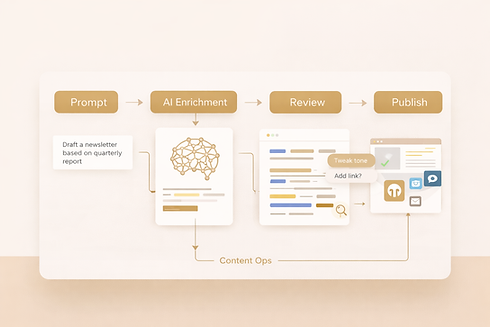
I designed a set of AI-assisted workflows to support early content drafting, product description consistency, and lightweight code generation for repeatable components. Each workflow was intentionally structured with clear prompt frameworks, layered review checkpoints, and accessibility considerations so outputs could be refined before publishing.
To support the commerce side of Kinaya Rising, I also built a lightweight POS and inventory structure connecting product data, SKU logic, and fulfillment tracking. This reduced manual updates and created a more reliable operational foundation as the catalog expanded.
Human-in-the-loop safeguards
-
Structured prompt templates to guide consistent outputs
-
Layered review checkpoints prior to publication
-
Fact-checking and manual validation for sensitive content
-
Accessibility and plain-language review built into the workflow
Throughout the process, AI functioned as a co-pilot within a human-centered system. The goal was not full automation, but a more efficient and scalable workflow that preserved clarity, brand voice, and usability.
Reflection
This work reinforced that AI is most effective when it augments human judgment rather than attempting to replace it. While AI-assisted tools reduced friction in repeatable tasks, maintaining clarity, accessibility, and brand voice still required intentional human oversight.
The experience also highlighted the importance of ethical guardrails. Structured prompts, layered review checkpoints, and clear data visibility helped ensure that efficiency gains did not come at the expense of accuracy, accessibility, or user trust.
Looking ahead, I see the role of AI in UX not as full automation, but as thoughtful augmentation. The opportunity is to design systems where AI accelerates routine work while humans remain accountable for quality, context, and user impact.


